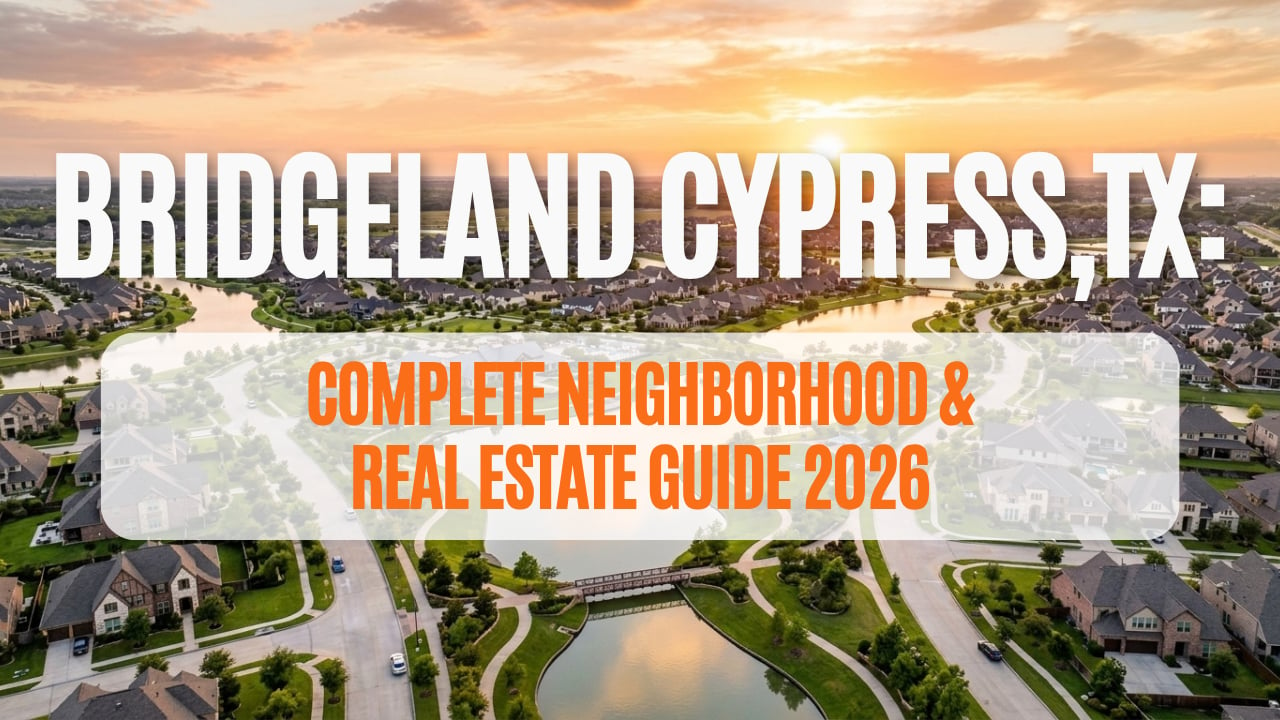
Bridgeland Cypress, TX: Complete Neighborhood & Real Estate Guide
Written by Gabrielle Strout, Luxury Realtor in Cypress, Texas
If you're considering buying a home in Bridgeland in Cypress, Texas, the first thing you should understand is the sheer scale of the community.
Bridgeland isn't simply a subdivision.
It's an approximately 11,500-acre master-planned community designed as a collection of distinct villages, with homes, schools, parks, lakes, trails, amenities, shopping and commercial development incorporated into a long-term plan.
And it is still growing.
That creates one of Bridgeland's biggest advantages—but also one of the most important considerations for buyers.
You can choose from an enormous range of homes, including significant new construction. But you also need to understand which village you're buying in, what builders are offering nearby, property taxes, future development and how all of those things could affect your home's value and your everyday life.
And now there's another major factor in that conversation: Toro District, the planned 83-acre sports, entertainment and commercial district anchored by the Houston Texans' future global headquarters and training complex.
I'm a Cypress resident and Realtor who works with buyers and sellers throughout Cypress, and Bridgeland is one of the communities I follow closely because it represents such a significant part of the 77433 real estate market.
Here's what I'd want one of my own clients to understand before buying or selling a home in Bridgeland.
Quick Answer: What Is Bridgeland in Cypress, TX Like?
Bridgeland is an approximately 11,500-acre master-planned community in Cypress, Texas, known for extensive parks, trails, lakes, newer homes and ongoing residential and commercial development.
Housing ranges from the $300,000s to more than $2 million in current builder offerings, while my analysis of recent MLS sales showed an even broader resale/new-construction range of approximately $249,000 to $3.1 million.
In my recent MLS analysis:
But here's where the data gets particularly interesting:
When I removed new construction and looked at resale homes only, average days on market dropped to approximately 69 days, while the average resale price increased to approximately $609,762.
That's a good example of why Bridgeland shouldn't be analyzed using one community-wide average.
New construction has a major influence on this market.
1. Where Is Bridgeland?
Bridgeland is located in Cypress, Texas, in northwest Greater Houston.
Much of the community is associated with ZIP code 77433, and its enormous footprint stretches across the Grand Parkway corridor.
The community is ultimately planned for approximately 70,000 residents at buildout.
That scale is important.
Bridgeland isn't being developed as a collection of streets surrounding one amenity center.
It's being developed more like a community within a community.
Homes, schools, recreation, retail, restaurants, employment and services are increasingly being incorporated into Bridgeland itself.
And that leads to one of the biggest things buyers need to understand:
Where you live within Bridgeland matters.
2. Bridgeland Is Divided Into Distinct Villages
When someone tells me they want to buy in Bridgeland, my next question isn't simply:
“What's your budget?”
I also want to know which part of Bridgeland makes sense.
Bridgeland's master plan identifies five major areas:
Lakeland Village
Parkland Village
Prairieland Village
Creekland Village
Bridgeland Central
Each has a different stage of development, housing inventory and character.
Lakeland Village
Lakeland was Bridgeland's first village and has grown to more than 3,000 households.
Because it's more established, buyers here are more likely to encounter resale inventory and mature landscaping than in the newest portions of Bridgeland.
Parkland Village
Parkland Village was designed around a park-oriented concept and offers established homes along with access to Bridgeland's trail and recreation network.
Prairieland Village
Prairieland represents a significant portion of Bridgeland's current and future growth.
It's planned for approximately 7,000 homesites, with homes spanning a broad range of prices and styles.
Creekland Village
Creekland encompasses approximately 2,300 acres and is expected to add roughly 3,000 homes to Bridgeland.
Bridgeland Central
Bridgeland Central is different.
Rather than functioning primarily as a residential village, it is being developed as Bridgeland's emerging commercial and urban center, with shopping, dining, offices, residential development and access to recreation.
It is also where Toro District is planned.
So saying, “I want to live in Bridgeland,” is really only the beginning of the conversation.
3. How Much Do Homes Cost in Bridgeland?
One reason Bridgeland attracts such a wide variety of buyers is its enormous housing range.
In my analysis of recent Bridgeland sales:
That means someone buying their first home can potentially be shopping in the same master-planned community as someone building or purchasing a multimillion-dollar luxury property.
That's unusual.
It also makes a single Bridgeland “average home price” much less useful than it appears.
A $350,000 home and a $2 million estate can both legitimately be described as Bridgeland homes.
They are not the same real estate market.
4. New Construction Is a Huge Part of the Bridgeland Market
This may be the most important real estate point in this entire guide.
In my recent MLS analysis, nearly 60% of Bridgeland sales were new construction.
That's enormous.
And it affects both buyers and sellers.
For buyers, it means you may have the opportunity to compare:
Different builders
Inventory homes
Homes under construction
Different lot sizes
One-story vs. two-story plans
Gated options
Different villages
Different design packages
Builder financing incentives
Resale properties
That's a lot of choice.
But choice also creates complexity.
The prettiest model home isn't necessarily the best real estate decision.
5. Why I Think Buyers Should Have Their Own Realtor When Buying New Construction
This is especially relevant in Bridgeland because there are so many builders and options.
The builder's sales representative works for the builder. As your Realtor, I'm looking at the purchase from your side.
That means I'm not just asking whether you like the floor plan.
I'm looking at questions such as:
How does this lot compare with others?
What's behind the property now—and what is planned there later?
How does this builder's pricing compare with nearby resale homes?
What incentives are being offered?
Is the builder's preferred financing actually the best financial option?
Are there completed homes that could create more negotiating leverage?
What are similar homes reselling for?
How much inventory is this builder carrying?
What happens when you eventually become the resale seller competing against that same builder?
Those are very different questions from:
“Which countertops do you like?”
New construction can be a great option. But it still needs to be analyzed as real estate.
6. Resale Buyers Are Competing With Builders—And That's Important
This is one of the most interesting dynamics in Bridgeland.
A resale home may be competing directly against:
Brand-new home + builder incentive + rate buydown + warranty + shiny model home.
That's tough competition.
But resale homes have advantages too.
A resale property may already include:
A pool
Mature landscaping
Window treatments
Upgraded lighting
Outdoor kitchen
Finished patio
Established yard
Built-ins
Appliances
Premium improvements
A lot that's no longer available from the builder
That's why buyers should compare finished product to finished product.
A builder's advertised base price and a fully completed resale home aren't necessarily comparable.
And sellers need to understand the reverse.
If a builder down the street is offering substantial incentives, you can't pretend that doesn't exist simply because your home isn't technically new construction.
7. My Resale-Only Data Tells an Interesting Story
Here's something I found particularly useful when analyzing Bridgeland.
When I looked at the overall market, including new construction:
Average sale price: $589,465
Average price/SF: approximately $199
Average DOM: 83
Then I removed new construction.
For resale homes only:
Average sale price: approximately $609,762
Average price/SF: approximately $199
Average DOM: 69
That doesn't mean resale is automatically “better” than new construction.
It tells us something more useful:
New construction materially changes the community averages.
That's why a seller shouldn't automatically price a resale home based on the headline Bridgeland statistics.
And a buyer shouldn't assume the community-wide average tells them whether an individual property is a good value.
You need to know what kind of property you're comparing.
8. Nature Is a Major Part of Bridgeland's Identity
If Towne Lake is defined by its recreational lake, Bridgeland is defined more broadly by nature woven throughout the community.
Bridgeland reports:
Approximately 11,500 total acres
More than 75 parks
Approximately 800 acres of existing lakes and waterways, with more planned
A planned 250-mile trail network
The trails aren't simply loops around an amenity center.
They're intended to connect villages, parks, schools, activity centers and commercial areas throughout the community.
For buyers relocating from more densely developed areas, this is one of the things that can be surprising about Cypress.
You can live in a major master-planned suburban community and still have extensive access to lakes, trails, parks and natural areas.
9. Bridgeland Is Designed Around an Outdoor Lifestyle
The amenity package goes well beyond trails.
Depending on where you live within Bridgeland, residents may have access to activity centers, pools, splash areas, playgrounds, pickleball, parks, lakes and other recreational facilities.
But I give Bridgeland buyers the same advice I give buyers considering any amenity-heavy community:
Don't count amenities. Ask yourself which ones you'll actually use.
If you're going to walk or bike the trails regularly, use the pools, kayak, take children to the parks or participate in community events, those amenities can meaningfully affect your lifestyle.
If you want to spend your weekends on your own acreage and never see your neighbors, Bridgeland probably isn't the obvious choice.
10. Property Taxes Are One of Bridgeland's Biggest Financial Considerations
This is an important one.
The approximate Bridgeland tax rate I've been using in my recent Cypress comparison research is around 3.2%, although the actual rate varies by property and taxing jurisdictions and must be independently verified.
Compare that with several communities I've researched:
The difference can be substantial.
Consider a hypothetical home with a $600,000 taxable value.
At 2.2%, the simple calculation is approximately:
$13,200 per year
At 3.2%:
$19,200 per year
That's approximately $6,000 per year—or $500 per month.
Actual property taxes depend on assessed value, exemptions and the individual taxing entities, so these numbers are illustrations rather than estimates for a particular home.
But they illustrate one of my biggest pieces of advice for Cypress buyers:
Don't shop by purchase price alone. Shop by total monthly cost.
11. Bridgeland's School Districts Require a Little More Explanation
Because Bridgeland is so large, the entire community isn't served by one school district.
Parts of Bridgeland are currently served by Cypress-Fairbanks ISD, while portions of Prairieland Village are served by Waller ISD.
You may also see references online stating that part of Prairieland Village will be served by Katy ISD.
That is part of the future development plan, but it's important to understand the distinction:
As of now, the future Prairieland sections planned for Katy ISD have not yet been released for residential development, so Katy ISD does not currently serve Bridgeland residents in those future sections.
Bridgeland describes Katy ISD as eventually serving the southern sections of Prairieland Village as that portion of the community is developed.
That's a good example of why buyers need to distinguish between what's currently available in Bridgeland and what's shown on the community's long-term master plan.
And regardless of which village you're considering:
Verify the school assignment for the individual address.
Attendance boundaries and development plans can change, particularly in rapidly growing communities.
12. Bridgeland Central Could Significantly Change Daily Life Here
One of the most interesting things about Bridgeland is that you're not only buying into what exists today.
You're buying into a community that is still evolving.
Bridgeland Central is the emerging mixed-use district along the Grand Parkway, designed to bring additional shopping, dining, employment and residential options into the community.
That matters because one of the traditional tradeoffs of suburban Houston has been:
More house and more space—but more driving.
As commercial development expands within Bridgeland, residents may increasingly be able to access restaurants, retail, services and potentially employment without leaving the community.
And one recently announced project has made this part of Bridgeland especially interesting.
13. What Could Toro District Mean for Bridgeland Home Values?
This is one of the questions I expect Bridgeland buyers and homeowners to ask a lot over the next several years.
In February 2026, the Houston Texans, Howard Hughes Communities and Harris County announced Toro District, an approximately 83-acre sports and entertainment development within Bridgeland Central.
The project is planned to include a 22-acre Houston Texans global headquarters and training complex with an indoor fieldhouse and three outdoor NFL practice fields.
But Toro District is much bigger than a football training facility.
Current plans also call for approximately:
1 million square feet of office space
300,000 square feet of retail and restaurants
250,000 square feet of healthcare and sports medicine
Two hotels
1,300 multifamily residential units
Flag football fields
Volleyball facilities
Parks
A Harris County annex
Additional entertainment and community space
The Texans and Howard Hughes say the district is projected to generate approximately $34 billion in long-term regional economic impact and more than 17,000 jobs over time. The current development concept is scheduled for completion in 2029, although plans and timing can evolve with a project of this scale.
Could Toro District increase Bridgeland property values?
Potentially—but I think homeowners need to be careful about treating that as a guarantee.
There are several reasons a development like Toro District could support housing demand over time.
It could bring more employment into Bridgeland.
It could bring additional restaurants, entertainment, healthcare and services closer to residents.
It could increase regional awareness of Bridgeland.
It could make Bridgeland more attractive to buyers who like the idea of living near a major mixed-use destination.
And additional infrastructure and commercial investment can make a suburban community feel increasingly self-contained.
Those factors can contribute to housing demand, and stronger demand can support property values.
But we're still early.
Toro District was announced in 2026, and there isn't enough post-development sales history to say:
“Toro District will increase your Bridgeland home's value by X%.”
I wouldn't trust anyone who tells you that.
Property values will still be affected by interest rates, housing inventory, builder incentives, property taxes, the broader Houston economy and the specific house you're selling.
There can also be tradeoffs.
Homes very close to major commercial or entertainment development may experience additional traffic, activity or other changes that some buyers will value differently.
So I view Toro District as a potential long-term demand driver for Bridgeland, rather than a guaranteed appreciation event.
And from a real estate perspective, I think that's the more useful way to look at it.
14. Today's Empty Field May Not Stay Empty
Toro District is actually a perfect example of why this matters.
This is one of the most important lessons for anyone buying in a rapidly developing master-planned community.
That beautiful open field behind the house?
Find out what it's designated for.
The road that seems quiet today?
Look at what future neighborhoods may eventually connect to it.
The commercial land nearby?
Understand what could be built there.
A community of this scale will continue changing.
That's not necessarily bad.
Future development can bring restaurants, stores, schools, employment, amenities and improved infrastructure.
But don't buy an assumption.
If a view, road, buffer or surrounding parcel is important to your decision, investigate the master plan and available development information before you purchase.
15. Bridgeland Is Becoming More Than a Bedroom Community
For years, many Houston suburbs functioned primarily as places where people lived while commuting somewhere else to work, shop and dine.
Bridgeland is increasingly being planned differently.
Commercial development is expanding, and Bridgeland Central is intended to create a more substantial retail, dining, office and residential core.
Toro District accelerates that transformation considerably.
The planned combination of the Texans headquarters, employment, healthcare, hotels, restaurants, retail, entertainment and sports facilities could bring a significant number of people into Bridgeland, rather than having residents constantly leave Bridgeland for those things.
That doesn't make Bridgeland an urban neighborhood.
You are still in suburban northwest Houston, and most households will remain car-dependent.
But the long-term goal is clearly to make more of everyday life possible within the larger Bridgeland community itself.
For a buyer planning to stay many years, that's worth understanding.
16. What Is the Commute Like From Bridgeland?
This depends enormously on where you're going.
In my experience working with Cypress buyers, Bridgeland can make particular sense for people whose employment or lifestyle keeps them in northwest or west Houston.
For buyers commuting toward the Energy Corridor, Bridgeland's access to the Grand Parkway can be useful.
Commuting all the way into Downtown Houston during rush hour is a different conversation.
The Woodlands is another route buyers should test rather than assuming it will be quick because the areas appear relatively close on a map.
My advice to relocation buyers is always:
Drive your actual commute at the actual time you'll be driving it.
Don't use Saturday afternoon traffic to make a Monday-morning housing decision.
17. Bridgeland vs. Towne Lake: What's the Difference?
These are probably the two Cypress communities I see compared most often.
And I don't think the answer should be:
“Which one is better?”
They're different.
Bridgeland
Bridgeland is significantly larger and still undergoing extensive development.
Its identity centers around interconnected villages, parks, lakes, trails, nature and long-term development.
It also currently offers substantial new-construction inventory.
Towne Lake
Towne Lake is smaller and more established.
Its identity is much more specifically centered around its approximately 300-acre recreational lake, waterfront lifestyle and Boardwalk.
My recent market research also shows an important price difference:
Those community-wide numbers shouldn't be used to conclude that one is a better value because the housing mix is very different.
But they do show why buyers should compare the two communities carefully.
Do you want Bridgeland's scale, nature, new-construction choices and enormous future development—or Towne Lake's lake-centered lifestyle and more established environment?
That's a much more useful question.
18. Luxury Homes Are a Real Part of the Bridgeland Market
Bridgeland isn't simply a mid-priced suburban community.
My MLS research showed sales reaching approximately $3.1 million.
Depending on current inventory, luxury buyers can find features such as:
Larger homesites
Gated neighborhoods
Custom or semi-custom construction
Premium water or green-space locations
Multi-generational layouts
Extensive outdoor living
Pools
Three- and four-car garages
High-end finishes
For luxury buyers, however, I would still apply the same rule:
Understand the micro-market.
A $1.5 million Bridgeland buyer has a very different competitive set from a $450,000 buyer.
19. Bridgeland Is Expanding Its Housing Options
Another interesting development is the continued diversification of housing within Bridgeland.
In 2026, Del Webb announced a new 190-acre gated 55+ community within Bridgeland planned for 672 homes, with its own amenity center in addition to access to Bridgeland amenities.
That fits a broader pattern.
Bridgeland isn't being designed around one stage of life or one price point.
Current and planned housing offerings span entry-level new construction, move-up homes, luxury properties, rental housing and dedicated active-adult options.
That can matter for someone who wants to remain in the same broader community as their housing needs change.
20. Who Might Love Living in Bridgeland?
Bridgeland deserves serious consideration if your priorities include:
New construction
Extensive builder choices
Parks and green space
Trails and outdoor recreation
Lakes and waterways
Master-planned amenities
A wide range of home prices
Newer infrastructure
Growing retail and dining options
Multiple housing types
A community with substantial future development
It may be particularly appealing to someone who wants a newer suburban environment but doesn't want the neighborhood to feel like endless streets of houses.
The parks, lakes, trails and preserved open spaces are a significant part of the design.
21. Who Might Prefer Another Cypress Neighborhood?
Bridgeland isn't automatically the right answer for every Cypress buyer.
You may want to compare other communities if your priorities include:
Lower property-tax rates
Mature trees
Older architectural variety
Very large established lots
Acreage
A fully built-out environment with less future construction
A recreational boating lifestyle
Golf-course frontage
Minimal HOA involvement
Someone prioritizing mature landscaping and a lower tax rate might prefer an established community such as Coles Crossing or Fairfield.
Someone who specifically wants boating and a waterfront lifestyle may prefer Towne Lake.
Someone who wants acreage may need to look outside the major master-planned communities entirely.
There isn't one “best neighborhood in Cypress.”
There's the neighborhood that makes the most sense for your priorities.
22. What I'm Seeing in the Bridgeland Real Estate Market
The biggest thing I see when analyzing Bridgeland is the influence of new construction.
Nearly 60% of the sales in my recent analysis were new homes. That means Bridgeland resale sellers aren't operating in a traditional resale-only market.
They're competing against builders.
And builders may have:
Inventory they need to move.
Financing incentives.
Closing-cost incentives.
Upgrade packages.
Brand-new model homes.
Marketing budgets.
That doesn't mean resale homes can't compete.
They absolutely can.
But the strategy needs to reflect reality.
A resale home may offer a better lot, established landscaping, a pool, completed improvements and features that would cost a new-construction buyer significant money after closing.
Those differences need to be identified, valued and marketed correctly.
And now I would add another factor to the long-term Bridgeland conversation:
Toro District.
I don't think we can quantify its effect on property values yet.
But an 83-acre sports, employment, healthcare, hospitality, retail and entertainment district anchored by an NFL team's headquarters is significant enough that buyers and sellers should understand what's planned and watch how the surrounding market responds as development progresses.
For buyers:
Don't assume new is automatically better. And don't assume resale is automatically the bargain.
Compare everything.
Price.
Taxes.
Lot.
Incentives.
Upgrades.
Future development.
Location within Bridgeland.
Proximity to Bridgeland Central and Toro District.
And what you're likely to compete against when you eventually sell.
That's how I think Bridgeland real estate should be analyzed.
Frequently Asked Questions About Bridgeland in Cypress, TX
Is Bridgeland a good place to live?
Bridgeland may appeal to buyers who value newer homes, extensive parks and trails, lakes, master-planned amenities and growing retail and commercial development. Buyers should also consider property taxes, commute, ongoing construction and the specific village before deciding whether it fits their priorities.
How big is Bridgeland?
Bridgeland encompasses approximately 11,500 acres and is ultimately planned for roughly 70,000 residents.
How much do homes cost in Bridgeland?
In my recent MLS analysis, sales ranged from approximately $249,000 to $3.1 million, with an average sale price of approximately $589,465.
Is Bridgeland still building new homes?
Yes. New construction remains a major part of the Bridgeland market. Nearly 60% of the recent sales in my MLS analysis were new construction.
What villages are in Bridgeland?
Bridgeland identifies Lakeland Village, Parkland Village, Prairieland Village, Creekland Village and Bridgeland Central in its master plan.
What is the property-tax rate in Bridgeland?
The approximate rate I've been using for comparison purposes is around 3.2%, although rates vary by property and taxing entities and can change. Buyers should verify the current rate for the individual property before purchasing.
Is Bridgeland in Cy-Fair ISD?
Parts of Bridgeland are currently served by Cypress-Fairbanks ISD, while portions of Prairieland Village are served by Waller ISD. Future southern sections of Prairieland are planned for Katy ISD, but those sections have not yet been released for residential development, so Katy ISD does not currently serve those future Bridgeland sections. School assignments should always be verified for the individual property.
What is Toro District in Bridgeland?
Toro District is a planned 83-acre sports, entertainment and mixed-use development in Bridgeland Central anchored by the Houston Texans' future global headquarters and training complex. Plans also include offices, healthcare and sports medicine, retail and restaurants, hotels, multifamily housing, sports facilities and parks.
Will Toro District increase Bridgeland home values?
It's too early to quantify its effect on Bridgeland home values. Large employment, retail, entertainment and infrastructure investments can contribute to housing demand, but property values are also affected by interest rates, inventory, taxes, builder incentives, the broader economy and individual property characteristics. I view Toro District as a potential long-term demand driver rather than guaranteed appreciation.
Is Bridgeland or Towne Lake better?
Neither community is universally better. Bridgeland offers a larger footprint, extensive new construction, trails, parks and significant future development. Towne Lake offers a more established environment centered around its recreational lake and boating lifestyle. The better fit depends on budget, taxes, commute, home preferences and lifestyle.
Should I use a Realtor when buying new construction in Bridgeland?
A buyer's Realtor can help evaluate builders, comparable resale properties, lots, incentives, future development and contract considerations from the buyer's perspective. The builder's sales representative represents the builder's interests.
My Perspective as a Cypress Realtor
One of the things I find most interesting about Bridgeland is that it demonstrates why “Cypress real estate” is too broad to analyze as one market.
Even Bridgeland itself isn't one market.
A resale home in Lakeland Village is different from a brand-new home in Prairieland.
A $400,000 buyer is competing in a different market from a $1.5 million buyer.
A premium green-space lot is different from a standard interior lot.
A resale home with a completed pool may compete very differently from a builder inventory home offering a financing incentive.
And over the next several years, proximity to major development such as Bridgeland Central and Toro District may become another factor buyers consider.
That's why I don't start with:
“Do you want to live in Bridgeland?”
I start with:
“What are you trying to accomplish?”
What's your comfortable monthly payment after taxes?
How important is new construction?
How much do you value the trail system?
What's your commute?
Do you want a pool?
Do you want mature landscaping—or do you prefer brand new?
How long do you expect to stay?
How comfortable are you with future development around you?
Once we answer those questions, we can determine whether Bridgeland makes sense—and then which part of Bridgeland makes sense.
That's a much better way to buy a house.
Data Behind This Bridgeland Guide
The real estate statistics and market observations in this guide were researched by Gabrielle Strout using Houston-area MLS sales data for the 12-month period ending September 2026.
Neighborhood statistics reflect closed sales and may include both new-construction and resale transactions unless otherwise indicated.
I separately analyzed Bridgeland resale transactions to better understand how the significant volume of builder sales affects community-wide statistics.
Property-tax rates are approximate and should be independently verified for the individual property. Actual taxes depend on assessed value, exemptions and specific taxing jurisdictions.
Real estate conditions change continuously, and individual Bridgeland properties can perform very differently based on village, builder, age, lot, condition, upgrades and competing new-construction inventory.
Information regarding future school districts and Toro District reflects currently announced development plans as of September 2026. Future development plans, boundaries and timelines can change.
About Gabrielle Strout
I'm Gabrielle Strout, a Cypress resident and Realtor with Compass Real Estate specializing in Cypress and the greater Houston area.
I've worked in Houston-area real estate for more than 13 years and have completed more than 240 home sales.
I work with buyers, sellers, relocation clients and international buyers, and my professional designations include Certified International Property Specialist (CIPS), Certified Luxury Home Marketing Specialist (CLHMS), Master Certified Negotiation Expert (MCNE) and Seniors Real Estate Specialist (SRES).

My approach is data-driven because Cypress isn't one real estate market.
And Bridgeland is a perfect example.
New vs. resale. Village vs. village. Builder vs. builder. Premium lot vs. standard lot. $400,000 vs. $1 million-plus.
Those differences matter.
Thinking About Buying or Selling a Home in Bridgeland?
If you're considering buying in Bridgeland, don't start with the model homes.
Start with your strategy.
What's your real budget after property taxes?
New construction or resale?
Which village?
What kind of lot?
What builder incentives are available?
What's planned around the property?
How close do you want to be to Bridgeland Central and future development such as Toro District?
What could you buy elsewhere in Cypress for the same monthly payment?
And what will your competition look like when you're eventually the seller?
Once we answer those questions, then we can go look at houses.
If you're selling a Bridgeland home, the same principle applies.
Your competition isn't every house in Bridgeland.
Your competition is the small group of new and resale homes a qualified buyer would realistically choose instead of yours.
That's the market we need to understand.