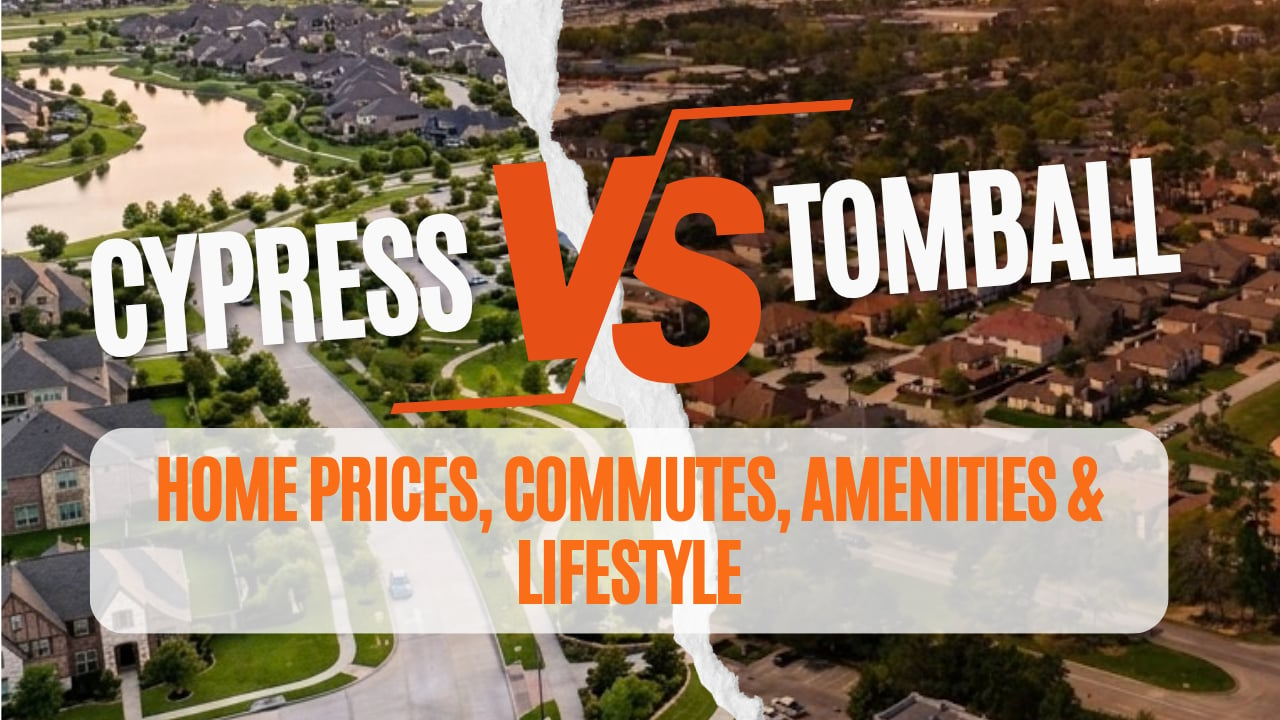
Cypress vs. Tomball: Home Prices, Commutes, Amenities & Lifestyle
Written by Gabrielle Strout, Luxury Realtor in Cypress, Texas
Thinking about moving to northwest Houston? Cypress and Tomball are two areas worth considering, especially if you want more space, established neighborhoods, newer master-planned communities, and access to the Houston job market. But while they’re neighbors on the map, living in Cypress can feel quite different from living in Tomball.
The right choice depends on more than the price of the house. Your commute, property taxes, preferred neighborhood style, weekend activities, and how much time you want to spend driving around town all matter.
As a Houston-area real estate professional, I encourage buyers to compare the specific neighborhoods they’re considering—not just the names Cypress and Tomball. Here’s how I’d break down the differences.
1. Two Northwest Houston Areas, Two Different Feels
Cypress is often a good fit for buyers who want a wide range of master-planned communities, neighborhood amenities, shopping, restaurants, and access to major roads like US-290 and the Grand Parkway.
Tomball may appeal to buyers who like a more small-town atmosphere, a historic downtown, community events, and a blend of established neighborhoods, acreage properties, and newer developments.
Neither area is automatically better. The question is which one fits the way you actually want to live.
If you’re deciding between a newer home in a Cypress master-planned community and a home near Old Town Tomball—or a property on the outskirts of Tomball—you may be comparing two very different lifestyles.
2. The Home Price Is Only One Part of the Decision
It’s easy to start your search by setting a budget and looking at homes online. But two homes with similar prices can come with very different monthly costs and daily routines.
For example, one home might have a lower purchase price but higher property taxes, a longer commute, or more driving to reach your usual shopping and activities. Another might cost more upfront but put you closer to work, parks, and the places you visit regularly.
There’s also an important local detail: Cypress and Tomball are broad area labels, not perfectly defined, city-to-city real estate markets. Listings marketed as Cypress or Tomball can fall into different ZIP codes, school attendance zones, tax districts, and commuting patterns.
That means a general online price comparison is a useful starting point—but it shouldn’t be the only thing you use to make your decision.
3. Compare Homes, Commutes, Amenities, and Everyday Life
Home prices: Which area gives you more for your money?
Recent market reports illustrate why it’s important to compare the data carefully.
A Houston-area Q2 2026 market report showed a median sales price of about $370,000 for the broader Cypress area. Within that report’s community breakdown, Cypress was listed around $417,000 and Tomball around $335,000. Those figures reflect the report’s geographic categories and are not a guarantee of what you’ll find in every neighborhood. View the Cypress-area market report.
HAR’s Tomball market report showed a median sales price of $356,000 in August 2026, with an average of 30 days on market. That figure uses HAR’s Tomball market definition, which may differ from other reports. Review Tomball market trends on HAR.
The takeaway? Tomball may offer attractive options at different price points, but you should compare homes with similar sizes, ages, conditions, lot sizes, and neighborhood features before deciding which area offers better value.
What you may find in Cypress:
A broad selection of master-planned communities and established neighborhoods.
Homes with community pools, trails, parks, playgrounds, or other amenities, depending on the subdivision.
New-construction options alongside resale homes.
A wide range of home styles and price points across the area.
What you may find in Tomball:
Established neighborhoods closer to town.
Newer subdivisions and master-planned developments.
Properties with larger lots or more space outside the denser suburban areas.
A mix of traditional suburban homes, newer builds, and some acreage options.
Always compare the full cost of ownership—not just the list price. Property taxes, homeowners insurance, HOA fees, potential MUD taxes, and maintenance can make a meaningful difference in your monthly payment.
Commutes: Where do you need to go every day?
For many buyers, the commute is the deciding factor.
Cypress has convenient access to major routes including US-290 and the Grand Parkway, but the experience depends heavily on where you live and which direction you travel. A home near one of those routes may be convenient for one job location and frustrating for another.
Tomball offers access to SH 249 and the Grand Parkway, along with connections to other northwest Houston corridors. Depending on your destination, that can work well—but living near Tomball’s historic downtown is a different commute setup from living farther north or west.
Here’s the key: don’t rely on a single estimated drive time for either area.
Before making an offer, test the drive from the actual property to your workplace at your usual departure time. If you work hybrid, check the commute on the days you’re expected in the office. If you regularly travel to the Energy Corridor, Downtown Houston, The Woodlands, or the Medical Center, compare each home against that destination separately.
Also consider the everyday trips that don’t show up on a commute calculator: school drop-offs, grocery runs, sports practices, and getting to your favorite restaurants.
Amenities: Shopping, restaurants, parks, and recreation
Both areas have plenty to offer, but the experience depends on where you settle.
Cypress: suburban convenience and neighborhood amenities
Cypress has a broad range of shopping and dining areas, along with parks, trails, sports facilities, and recreational spaces. Many newer communities are designed around shared amenities, while established neighborhoods may offer mature landscaping and convenient access to everyday services.
One example is John Paul Landing Park, a large Harris County park in the Cypress area with trails, fishing, playgrounds, picnic areas, and a lake. It’s a good reminder that Cypress living isn’t only about subdivisions and shopping centers—there are outdoor spaces to enjoy, too.
Tomball: small-town character and outdoor options
Tomball’s identity is closely tied to its historic downtown, local events, and community atmosphere. Old Town offers a different experience from a typical shopping-center corridor, and local parks provide options for outdoor activities.
The city lists parks including the Theis Attaway Nature Center, Juergens Park, Jerry Matheson Park and pool, and Wayne Stovall Sports Complex. You can explore the city’s official parks and recreation information.
If you enjoy a walkable historic district, local festivals, and a town center with its own identity, Tomball may have a special appeal. If you prefer having a wide selection of suburban shopping and neighborhood amenities spread throughout the area, Cypress may feel more familiar.
Of course, neither area is one-size-fits-all. The exact subdivision and its distance from the places you use will matter just as much as the city or area name.
4. Look at the Data—and Then Look at the Actual Neighborhood
Market statistics help you understand the broader picture, but they don’t tell the whole story.
The Q2 2026 Cypress-area report showed a median sales price of $370,000 and an average of 54 days on market for the broader area. HAR’s August 2026 Tomball report showed a median sales price of $356,000 and 30 days on market under its market definition. These are useful reference points, but the reports cover different geographic groupings and time periods, so they should not be treated as a perfectly matched comparison.
A more useful comparison is to select a few neighborhoods in each area and look at similar homes that have actually sold.
For each neighborhood, I’d want to know:
What are comparable homes selling for—not just listed for?
How long are similar homes taking to sell?
Are buyers negotiating seller concessions or price reductions?
How much do property taxes and HOA fees add to the monthly cost?
Are there new-construction homes competing with resales nearby?
What do homes in your price range offer in terms of size, condition, lot, and amenities?
That last point is especially important. A resale home competing against a builder’s incentives may need to offer something extra to stand out. Updated finishes, a well-maintained property, a desirable lot, or a competitive price can all affect how a home performs.
The best decision comes from current, neighborhood-level data—not from assuming one entire area is cheaper or a better investment.
5. What Buyers Should Think About Before Choosing
Here are some of the practical differences I’d discuss with someone deciding between Cypress and Tomball.
Neighborhood style
If you’re drawn to a master-planned lifestyle with amenities woven into the community, Cypress has many options to explore. But amenities and fees vary, so confirm what a particular subdivision actually includes.
Tomball offers a broader mix of settings, from neighborhoods close to downtown to newer developments and properties with more land. If you want a larger lot or a little more separation from neighboring homes, widen your search beyond the most familiar suburban subdivisions.
Property taxes and monthly costs
Don’t assume all Cypress homes have the same tax rate—or that every Tomball property is taxed alike. The total depends on the specific taxing entities, including county, school district, city where applicable, and any municipal utility district.
Two homes with similar prices can have different tax bills. Before you make a decision, verify the actual property tax information for each address and ask about any HOA or special district fees.
Schools and attendance zones
School assignments can vary by address, even within the same general area. If school location is important to your decision, verify the current attendance zone for the specific property rather than relying on a subdivision name or a general map.
Also consider the practical school run: where the campus is, how traffic flows at drop-off and pick-up, and whether the route works with your schedule.
New construction versus resale
Both areas have newer developments and resale opportunities, but the choices available will vary by price range and location.
If you’re considering a new build, compare the builder’s total package—including incentives, upgrades, lot premiums, and estimated taxes—with the cost of a comparable resale home. If you’re buying resale, pay attention to condition, recent updates, and whether the price reflects the competition.
Your everyday routine
This is the part buyers sometimes overlook. Picture an ordinary Tuesday, not just a Saturday showing.
Where will you buy groceries? How far is the gym? Where will the kids play sports? How long does it take to get to work? Can you meet friends for dinner without making it a major trip?
The right home is one that fits your life on the days when nothing special is happening.
6. How to Decide Between Cypress and Tomball
Use this quick checklist before narrowing your search.
Cypress may be the better fit if you:
Want to compare a wide range of master-planned communities and established subdivisions.
Prefer having numerous suburban shopping and dining options across the area.
Want access to neighborhood amenities such as pools, trails, parks, or recreation facilities where available.
Have a commute that works well with the part of Cypress you’re considering.
Tomball may be the better fit if you:
Like the character and community feel associated with a historic downtown.
Want to explore a mix of established neighborhoods, newer developments, and properties with larger lots.
Enjoy local events and a town-center atmosphere.
Have a commute that works with the Tomball location you’re considering.
Then take these five steps:
Set your total monthly budget. Include principal and interest, property taxes, insurance, HOA fees, and any MUD taxes or other applicable charges.
Choose your commute destinations. Test drive times from actual homes during the hours you would normally travel.
Compare specific neighborhoods. Look at recent sales, current competition, lot sizes, home condition, and amenities.
Visit both areas at different times. Drive through on a weekday morning, during the evening commute, and on a weekend. Notice traffic, noise, shopping convenience, and the feel of the neighborhood.
Verify the details for each address. Confirm tax rates, school attendance zones, HOA restrictions and fees, and any community amenities before you commit.
You don’t need to decide whether Cypress or Tomball is universally better. You need to identify which area has the right home, location, and costs for your priorities.
7. Let’s Find the Right Fit for You
If you’re deciding between Cypress and Tomball, I can help you compare neighborhoods based on your budget, commute, preferred home style, and day-to-day needs.
The goal isn’t just to find a house that looks great online. It’s to find a home that makes sense for your finances and the way you want to live.

Thinking about moving to Cypress or Tomball? Reach out and tell me your price range, where you commute, and what matters most to you. We can narrow down the areas worth exploring and compare the options that make the most sense for you.