Houston Metro · Cypress, TX
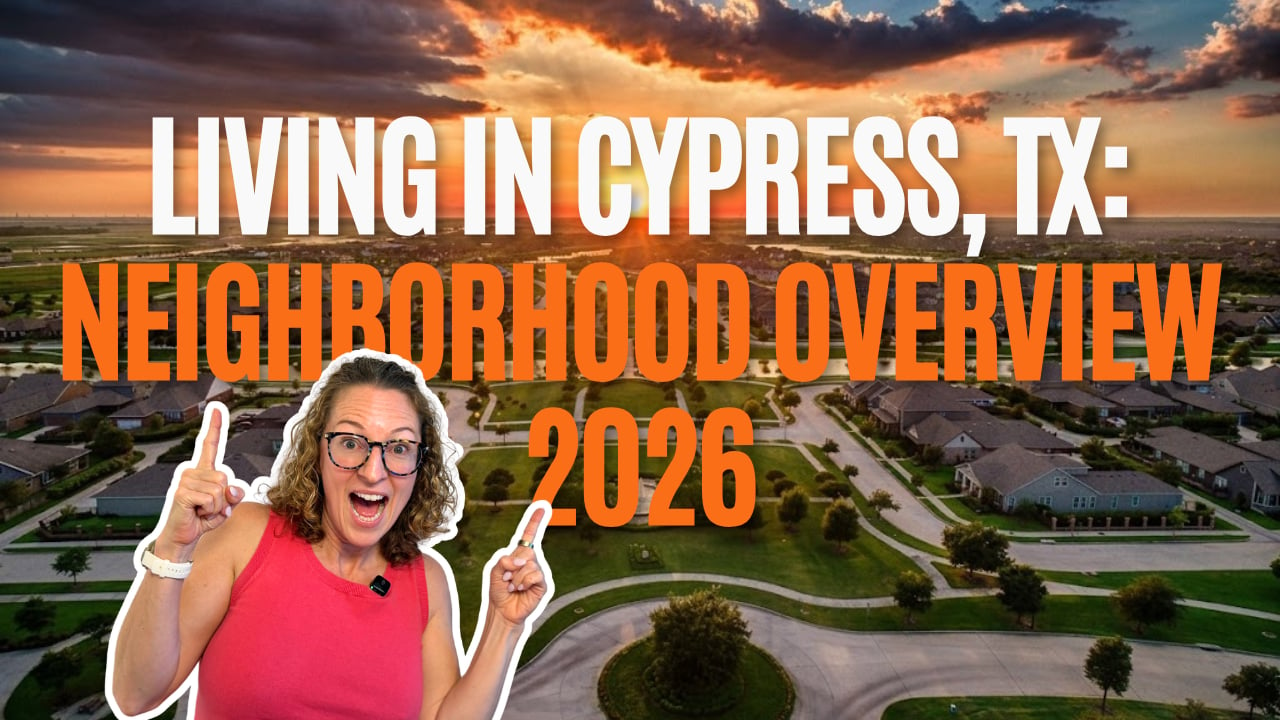
Living in Cypress, TX: Neighborhood Overview 2026
A neighborhood-by-neighborhood look at what it actually costs, where it floods, what a pool is worth, and who Cypress is (and isn't) right for — built from a year of local sales data.
If you're thinking about moving to Cypress, Texas, one of the first things to understand is that “Cypress” isn't one single type of community — or even one single real estate market.
You can find established neighborhoods with mature trees, newer master-planned communities with resort-style amenities, golf-course homes, waterfront properties, homes on larger lots and luxury properties selling well over $1 million. You can also find significant differences in home prices, property taxes, commute times and even how quickly homes sell depending on which part of Cypress you're considering.
I live in Cypress and have worked in Houston-area real estate for more than 13 years. One of the biggest mistakes I see relocation buyers make is trying to evaluate Cypress as a whole instead of comparing its individual neighborhoods and micro-markets.
This guide is designed to help you understand those differences.
Quick Answer
What Is It Like Living in Cypress, Texas?
Cypress is a large suburban area northwest of Houston known for spacious homes, master-planned communities, parks and trails, newer development and a surprisingly broad range of housing options.
One thing that consistently surprises my relocation clients is how much space they can get here — not just inside the house, but in the form of larger lots, green space, lakes, trails and parks throughout many Cypress communities.
But there are tradeoffs.
Cypress is growing rapidly, and that growth brings traffic, road construction and continued development. Property-tax rates can also vary substantially between communities, and the large amount of new construction means resale buyers often have more options to compare.
The key is finding the part of Cypress that matches your priorities rather than simply searching for “a house in Cypress.”
Where Is Cypress, Texas?
Cypress is northwest of central Houston and is generally centered around the US-290 corridor, with the Grand Parkway/99 providing additional north-south connectivity.
For commuters, location within Cypress matters.
A home with convenient access to 290 may work very differently for someone commuting toward the Energy Corridor or central Houston than a home farther west or north. Two houses can both have a Cypress address yet create very different daily commutes.
This is something I encourage relocation buyers to consider early in their search. It's easy to fall in love with a house and only afterward realize that its location doesn't work particularly well for your daily routine.
Cypress continues to expand its road infrastructure as the area grows, but rapid population and housing growth inevitably creates some growing pains. Expect ongoing road improvements — and traffic — as development continues.
Micro-Markets
Cypress Isn't One Real Estate Market: 77429 vs. 77433
One of the easiest ways to see the differences within Cypress is to compare its two primary ZIP codes: 77429 and 77433.
Here is what the previous 12 months of sales looked like:
Last 12 Months | Cypress 77429 | Cypress 77433 |
|---|---|---|
Homes Sold | 961 | 2,543 |
Median Sale Price | $380,000 | $434,308 |
Average Sale Price | $374,184 | $509,259 |
Average Price/Sq. Ft. | $155.21 | $180.08 |
Average Days on Market | 74 | 83 |
The median sale price in 77433 was approximately 14% higher than in 77429, while the average price per square foot was approximately 16% higher.
The difference in average sale price was even larger.
That doesn't mean 77433 is simply “better” or that every home there is more expensive. It reflects significant differences in the housing stock.
Much of Cypress's newer development — including major master-planned communities and a substantial amount of new construction — is concentrated in 77433. The ZIP code also includes a significant number of higher-end properties.
77429 contains many more established neighborhoods, including communities with mature trees, larger lots and homes that may have been built decades earlier.
For some buyers, that's exactly the appeal.
What I'm Seeing as a Cypress Realtor
Buyers often tell me they're looking in “Cypress”
…as though that's one housing market. Once we start touring homes, they quickly realize how different the options can be.
Newer doesn't automatically mean better.
Some buyers want a newer home with current finishes and extensive community amenities. Others would happily renovate a kitchen in exchange for mature trees, a larger lot, lower property taxes or a location that would be difficult to recreate in a new development.
Understanding those tradeoffs is much more useful than simply comparing list prices.
How Much Does It Cost to Buy a Home in Cypress?
Cypress has a wider range of home prices than many people expect.
I analyzed 3,482 Cypress home sales across five price ranges during the period studied.
Sale Price | Homes Sold | Approx. Share of Sales |
|---|---|---|
Under $400,000 | 1,620 | 46.5% |
$400,000–$500,000 | 692 | 19.9% |
$500,000–$750,000 | 781 | 22.4% |
$750,000–$1 Million | 253 | 7.3% |
$1 Million+ | 136 | 3.9% |
Approximately two-thirds of these Cypress home sales occurred below $500,000.
At the same time, Cypress has a meaningful higher-end market. There were 389 sales at $750,000 or above, including 136 sales over $1 million.
That combination is one reason broad statements about the “Cypress market” can be misleading.
A buyer with a $400,000 budget and a buyer with a $1.5 million budget can both realistically shop in Cypress — but they're looking at very different properties and potentially very different communities.
What Different Budgets Can Buy
Below $400,000, buyers can find resale homes throughout Cypress along with some smaller or entry-level new-construction options.
Between $400,000 and $500,000, the choices expand considerably across both established neighborhoods and newer developments.
From $500,000 to $750,000, buyers begin seeing larger homes, more upgraded properties, premium lots and higher-end sections of master-planned communities.
Above $750,000, Cypress offers luxury homes, waterfront properties, golf-course homes, larger lots, custom construction and properties that can exceed $2 million.
Neighborhood Data
Cypress Neighborhoods: Why the Micro-Market Matters
Looking at individual communities reveals something that Cypress-wide statistics can't.
I analyzed recent sales in several well-known Cypress neighborhoods. The differences are significant.
Community | Approx. Price Range | Avg. Sold Price | Avg. $/Sq. Ft. | Avg. DOM |
|---|---|---|---|---|
Towne Lake | $330K–$2.5M | $784,000 | $217 | 82 |
Bridgeland | $249K–$3.1M | $589,465 | $199 | 83 |
Coles Crossing | $269K–$900K | $517,816 | $165.65 | 79 |
Longwood Village | $300K–$955K | $487,329 | $159.73 | 71 |
Marvida | $280K–$1.2M | $416,000 | $170 | 130 |
Dunham Pointe | $420K–$1.3M | $740,505 | $201 | 103 |
Fairfield | $220K–$1.3M | $436,116 | $158.64 | 68 |
But the averages aren't the most interesting part.
What happens inside these communities tells us much more about what Cypress buyers currently value.
Towne Lake
Towne Lake had an average sale price of approximately $784,000 and the highest average price per square foot among the communities I analyzed at approximately $217 per square foot.
The price range is enormous — from roughly $330,000 to $2.5 million — which illustrates the variety within the community itself.
Recent sales volume, however, has been decreasing compared with the previous year.
That doesn't mean demand has disappeared. It means buyers currently have more alternatives, and sellers need to understand what they're competing against.
Bridgeland
Bridgeland's numbers require some interpretation.
Nearly 60% of the sales I analyzed were new construction.
Including new construction, homes averaged approximately 83 days on market, $199 per square foot and an average sale price of $589,465.
When I removed new construction from the analysis, something interesting happened.
Resale homes averaged approximately 69 days on market, while the average price per square foot remained essentially unchanged at $199. The average resale price increased to approximately $609,762.
That's a good example of why headline neighborhood statistics don't always tell the full story.
A resale seller in Bridgeland isn't just competing with another homeowner down the street. They're competing with builders, inventory homes and potentially builder financing or closing-cost incentives.
Coles Crossing
Coles Crossing tells a different story.
This is an established community where many homes are reaching the age when buyers expect renovations.
The pattern I'm seeing is clear: remodeled homes are winning.
Updated properties are generally experiencing shorter marketing times and stronger sale-price ratios than homes requiring significant cosmetic renovation.
That doesn't mean every seller needs to gut a kitchen before listing. It means condition needs to be reflected honestly in the pricing strategy.
Longwood Village
Longwood produced one of the most interesting findings in my analysis.
Homes with pools sold for approximately 8% more per square foot and sold approximately 26% faster than homes without pools.
That suggests pools are currently creating meaningful differentiation in this particular community.
But that doesn't mean the same thing happens everywhere in Cypress.
Fairfield
In Fairfield, fewer than one-quarter of the homes sold had pools.
Those pool homes achieved approximately 7% higher sale prices, but having a pool didn't materially reduce the time required to sell.
Compare that with Longwood, where pool homes sold considerably faster.
Why This Matters
There isn't one Cypress-wide rule for what an upgrade is worth.
A pool can influence buyer behavior differently in Longwood than in Fairfield. The same applies to remodeling, lot size, location, outdoor improvements and other features.
That's why neighborhood-specific sales data is much more useful when evaluating a home than relying exclusively on Cypress-wide averages.
New Construction Is Reshaping Cypress Real Estate
Few trends are influencing Cypress real estate more than new construction.
In my analysis:
- Nearly 60% of Bridgeland sales were new construction.
- Nearly 80% of Marvida sales were new construction.
- New construction also represented the majority of sales in Dunham Pointe.
This creates opportunities for buyers — but also significant competition for resale sellers.
Marvida
Marvida had an average sale price of approximately $416,000 and an average market time of 130 days.
With builders accounting for nearly 80% of the sales I analyzed, resale sellers are competing directly against new homes.
A resale owner trying to sell in this environment should currently be prepared for a marketing period that could approach five months, depending on price, condition and competition.
Dunham Pointe
Dunham Pointe had an average sale price of approximately $740,505 and an average price per square foot of $201.
Although you may occasionally see resale properties in the $400,000s, those homes are relatively uncommon and may be discounted while competing against new construction.
Buyers shouldn't assume that seeing a $400,000 resale means comparable newly built homes are available at the same price.
What This Means for Resale Sellers
Today's buyer can compare your 10- or 20-year-old home with a brand-new property — sometimes within a short drive.
That changes expectations.
Buyers aren't necessarily rejecting older homes. What they're increasingly resisting is the combination of:
If the house needs work, buyers may expect the price or seller concessions to reflect it.
Property Taxes in Cypress Can Vary More Than Buyers Expect
One of the biggest financial mistakes a buyer can make is comparing Cypress homes based solely on sale price.
Property-tax rates vary considerably by community and taxing jurisdiction.
Here are approximate rates for several Cypress communities:
Community | Approx. Tax Rate |
|---|---|
Fairfield | 2.2% |
Coles Crossing | 2.2% |
Towne Lake | 2.4% |
Bridgeland | 3.2% |
Dunham Pointe | 3.2% |
Marvida | 3.3% |
Consider two hypothetical homes with the same $600,000 taxable value.
At a 2.2% tax rate, annual property taxes would be approximately $13,200.
At 3.3%, they would be approximately $19,800.
Actual taxes depend on assessed value, exemptions and the specific taxing authorities applicable to an individual property, so buyers should always verify the taxes for the specific home.
But the example demonstrates why I encourage buyers to compare total ownership cost, not simply purchase price.
A less expensive home isn't necessarily less expensive to own.
Does Cypress Flood?
The useful answer isn't simply yes or no.
Flood risk is property-specific, and buyers should investigate the individual home rather than assuming that an entire Cypress ZIP code or neighborhood has the same risk.
When I'm helping buyers evaluate a property, I want to understand its flood-zone designation, available flood history, seller disclosures, surrounding drainage and detention infrastructure, and any other property-specific factors that could affect risk.
Buyers should also evaluate flood insurance when appropriate.
A home being outside a designated high-risk flood zone doesn't mean flooding is impossible, just as the presence of nearby detention ponds or drainage infrastructure shouldn't automatically be viewed negatively. These systems are part of how stormwater is managed in a rapidly developing area.
Due diligence matters.
New Construction or an Established Cypress Neighborhood?
This is one of the most common choices Cypress buyers face.
Neither option is automatically better.
Newer Cypress communities can offer modern floor plans, energy-efficient construction, contemporary finishes, extensive amenities and opportunities to purchase directly from builders.
Established neighborhoods may offer mature trees, larger lots, established landscaping, different locations and potentially lower property-tax rates.
Some property types are also difficult to recreate.
For example, if you're specifically looking for an established golf-course home in Cypress, you have several options — but the home itself may need updating.
The tradeoff might be accepting an older kitchen or bathroom in exchange for a golf-course lot, mature landscaping and a location that isn't being recreated by new construction.
The question shouldn't simply be:
It should be:
What Relocation Buyers Find Surprising About Cypress
After working with relocation buyers from around the United States and internationally, several reactions come up repeatedly.
How Much Space You Can Get
Clients are often surprised by the size of both the homes and lots available in Cypress.
Compared with some other Houston suburbs, including parts of Katy, buyers can find properties that feel remarkably spacious.
That can be particularly appealing to someone relocating from a denser city or another part of the country where the same housing budget buys considerably less space.
How Much Green Space There Is
Another surprise is the amount of nature.
Cypress isn't simply endless subdivisions.
Depending on the community, buyers can find lakes, trails, parks, mature trees, preserved green areas and extensive outdoor amenities.
Communities such as Bridgeland and Towne Lake have incorporated outdoor recreation heavily into their designs, while older Cypress neighborhoods can offer mature tree canopies that take decades to reproduce.
The Commute Can Be Better — or Worse — Than They Expected
Looking at a map of Houston doesn't always tell you what a commute will actually feel like.
Some relocation buyers are surprised by how Cypress compares with commuting from Katy, particularly depending on their workplace and proximity to major roads.
For anyone commuting regularly, I recommend evaluating the specific home-to-work route, not simply comparing the names of suburbs.
What Are the Tradeoffs of Living in Cypress?
Cypress's growth is simultaneously one of its biggest strengths and one of its biggest challenges.
The area continues to attract residential development, restaurants, shopping and major investment.
That means more options close to home.
It also means traffic and construction.
Roadways are being expanded and transportation infrastructure continues to improve, but infrastructure takes time to catch up with rapid growth.
If you move to a fast-growing area, some growing pains come with the territory.
Buyers should also consider property taxes, insurance costs, commute requirements and the ongoing development surrounding newer communities.
Someone looking for highly walkable urban living close to central Houston may reach a very different conclusion about Cypress than someone prioritizing space, newer housing, outdoor amenities and suburban living.
What's Happening in the Cypress Real Estate Market in 2026?
The biggest change I'm seeing in Cypress right now is simple:
Sales volume has decreased compared with this time last year, while buyers have considerable inventory to compare.
And new construction is a major part of that competition.
This is creating a more discerning buyer.
A home doesn't necessarily need to be completely remodeled to sell. But buyers are paying attention to condition, and when a home needs substantial updating, they increasingly expect either the price or seller concessions to compensate for it.
We're seeing this particularly clearly in established neighborhoods such as Coles Crossing, where updated properties are separating themselves from homes that need renovation.
Meanwhile, sellers in newer communities may be competing against builders offering brand-new homes and financial incentives.
What the Numbers Don't Tell You
This is why I don't particularly like reducing a market to “buyer's market” or “seller's market.”
The answer can change by neighborhood, price range and property type.
A beautifully updated home in an established Cypress neighborhood can behave very differently from a dated property two streets away.
A resale home in Bridgeland can face different competition from one in Fairfield.
And a golf-course property may attract a buyer specifically because there isn't a comparable new-construction alternative.
Understanding which one you're actually buying or selling in matters.
Is Cypress Right for You?
There isn't one Houston suburb that's right for everyone.
Cypress may deserve a closer look if your priorities include:
- More space and larger suburban homes
- Master-planned community amenities
- Parks, trails and green space
- New construction
- Established neighborhoods with mature trees
- Luxury housing
- Golf-course properties
- Larger lots
- Multigenerational floor plans
- Access to northwest Houston and the US-290/Grand Parkway corridors
On the other hand, someone whose top priority is dense, walkable urban living or a very short daily commute into central Houston may evaluate Cypress differently.
The better question isn't whether Cypress is universally “good.”
It's whether Cypress fits the way you want to live, what you want to spend and where you need to go every day.
FAQ
Frequently Asked Questions About Living in Cypress, Texas
Is Cypress, Texas a good place to live?
Cypress offers a wide range of housing, master-planned communities, established neighborhoods, parks, trails, restaurants, shopping and access to northwest Houston. Whether it's the right location for you depends on priorities such as commute, budget, property taxes, desired home style and amenities. Because Cypress covers a large area, individual neighborhoods can provide very different experiences.
What is the average home price in Cypress?
Home prices vary substantially by ZIP code and neighborhood. During the 12-month period analyzed for this guide, the median sale price was approximately $380,000 in 77429 and $434,308 in 77433. Individual Cypress communities ranged from homes in the $200,000s to luxury properties exceeding $3 million.
Is 77429 or 77433 more expensive?
Based on the 12-month sales data analyzed for this guide, 77433 had higher median and average sale prices. Its median was approximately $434,308 compared with $380,000 in 77429. However, each ZIP code contains multiple neighborhoods and price ranges, so buyers should compare specific communities and properties rather than choosing based on ZIP code alone.
What are some of the major neighborhoods in Cypress?
Well-known Cypress communities include Towne Lake, Bridgeland, Fairfield, Coles Crossing, Longwood Village, Cypress Creek Lakes, BlackHorse Ranch, Marvida and Dunham Pointe, among others. They vary considerably in age, price, amenities, lot sizes, tax rates and amount of new construction.
Are property taxes high in Cypress?
Property-tax rates vary significantly. In the communities analyzed for this guide, approximate rates ranged from around 2.2% in Fairfield and Coles Crossing to approximately 3.3% in Marvida. Buyers should verify the current rate, assessed value and applicable exemptions for the individual property.
Does Cypress have a lot of new construction?
Yes, particularly in western Cypress and newer master-planned communities. In the sales analyzed for this guide, nearly 60% of Bridgeland transactions and nearly 80% of Marvida transactions involved new construction. This provides buyers with significant choice but also creates additional competition for resale sellers.
How long does it take to sell a home in Cypress?
It depends heavily on the neighborhood, price and property. Among the communities analyzed for this guide, average days on market ranged from approximately 68 days in Fairfield to 130 days in Marvida. Condition also matters: in several established neighborhoods, updated properties are outperforming homes requiring significant renovation.
Data behind this guide. Market statistics were researched by Gabrielle Strout using Houston-area MLS sales data for the 12-month period ending September 2026.
Neighborhood statistics reflect closed sales and may include both new-construction and resale transactions unless otherwise indicated. Price ranges represent properties reflected in the analyzed sales data.
Market conditions change continuously, and individual properties can perform very differently from neighborhood averages. Tax rates are approximate and should be independently verified for the individual property.
The analysis and observations throughout this guide are based on both the sales data and Gabrielle's firsthand experience working with buyers and sellers throughout Cypress.
Thinking About Moving to Cypress?
Instead of starting with a list of houses, start with what matters to you — budget, commute, home style, taxes, lot size, amenities and your tolerance for renovations. Those priorities are what actually narrow down which Cypress communities make sense.