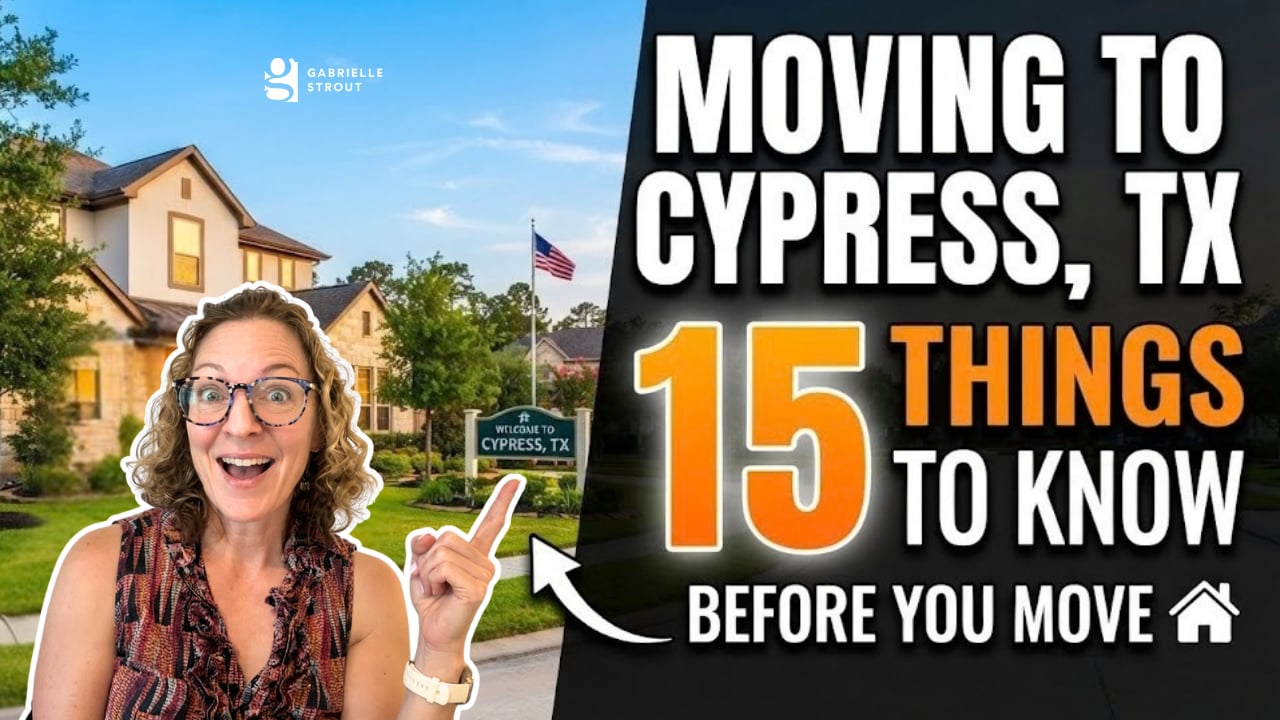
Moving to Cypress, TX: 15 Things to Know Before You Move
Written by Gabrielle Strout, Luxury Realtor in Cypress, TX
If you're thinking about moving to Cypress, Texas, here's the first thing I want you to know:
Two neighborhoods five miles apart can give you a completely different experience of living in Cypress.
You could choose a newer master-planned community with miles of trails, resort-style amenities and a property-tax rate above 3%. Or you could buy an older home surrounded by mature trees, with a larger lot and a considerably lower tax rate.
Your commute can change. Your monthly payment can change. Even what you do on a Saturday morning can change.
I know this both as a Realtor and as someone who made the move myself. I relocated to Cypress from Houston's Energy Corridor thinking, How different could it really be?
Quite a bit, as it turns out.
So before you choose a house—or even a neighborhood—here are 15 things I think you should know about moving to Cypress, Texas.
Quick Answer: What Should You Know Before Moving to Cypress, TX?
Cypress is a large suburban area northwest of Houston with everything from established neighborhoods and larger lots to major master-planned communities such as Bridgeland and Towne Lake. Home prices vary significantly, but approximately two-thirds of the Cypress sales I recently analyzed were below $500,000. Buyers should pay particular attention to neighborhood location, commute times, property and MUD tax rates, new-construction competition, flood and drainage considerations, and the differences between 77429 and 77433.
One of the biggest surprises for my relocation clients is how much space and green space they can get in Cypress. One of the biggest mistakes is choosing a house before understanding how its specific location will affect everyday life.
[Put link to YouTube video here if possible]
1. Cypress Is Much Bigger and More Varied Than It Looks on a Map
People often start their home search by saying, “We're looking in Cypress.”
That's a little like saying, “We're looking in Houston.”
Cypress isn't an incorporated city with a small, clearly defined downtown surrounded by neighborhoods. It's a large unincorporated area of northwest Harris County, and the housing, traffic patterns, development and overall feel can vary considerably depending on where you are.
You'll frequently encounter two ZIP codes in Cypress searches: 77429, 77433.
And those two areas don't necessarily look or feel the same.
2. Understand the Difference Between 77429 and 77433
If I were relocating to Cypress, this is one of the first distinctions I'd want to understand.
Here's what the previous 12 months of sales looked like in the two primary Cypress ZIP codes:
The median sale price in 77433 was approximately 14% higher, while its average price per square foot was approximately 16% higher.
But the differences aren't simply about price.
Why 77429 Feels Different
Some of the older portions of Cypress around Huffmeister and Spring Cypress developed gradually from former ranch and farmland beginning decades ago.
That means you'll find established neighborhoods with mature trees, larger lots and a much wider variety of housing styles and ages.
Some buyers love that.
They aren't necessarily looking for every house on the street to look coordinated. They'd rather have a third-acre lot, mature oak trees or an established golf-course location.
Why 77433 Feels Different
Much of the Highway 99/Grand Parkway corridor developed very differently.
Large master-planned developers acquired substantial contiguous parcels that could be developed into what are essentially self-contained communities, complete with new infrastructure, lakes, trails, recreation centers, retail and other amenities.
That creates a more cohesive master-planned feel.
If you love newer construction, extensive amenities and a more contiguous neighborhood design, you may gravitate toward 77433.
If you prioritize mature trees, larger lots, established neighborhoods and potentially lower tax rates, parts of 77429 may appeal to you more.
Neither is inherently better. They're different.
3. Cypress Has a Much Wider Range of Home Prices Than People Expect
Cypress gets attention for communities with multimillion-dollar homes, but luxury properties are only one part of the market.
I analyzed 3,482 recent Cypress home sales by price range:
Approximately two-thirds of those sales occurred below $500,000.
At the same time, 389 properties sold for $750,000 or more.
So someone with a $350,000 budget and someone with a $1.5 million budget could both reasonably tell me they're considering Cypress.
They're just shopping in very different markets.
4. Buyers Have More Negotiating Power Than They Did a Few Years Ago
If your mental picture of buying a Houston-area home still involves 15 offers by Sunday night and waiving every protection you have, the market has changed.
Buyers currently have substantially more inventory to compare, and sales volume has been declining compared with last year.
That doesn't mean every seller is desperate to negotiate.
A beautifully updated, properly priced home can still attract considerable attention. Unique properties can behave differently, too.
But buyers generally have more opportunity to negotiate terms such as price, repairs, closing-cost assistance or seller concessions that can potentially be used toward an interest-rate buydown, subject to their loan program and lender requirements.
What I'm Seeing in the Cypress Market
Buyers have become much more selective about condition.
They're not necessarily unwilling to buy an older home.
They're unwilling to pay an updated-home price for a property that needs $75,000 worth of updating—especially when they're simultaneously comparing it with new construction.
For sellers, pricing accurately from the beginning matters tremendously in this environment.
5. Bridgeland and Towne Lake Aren't Interchangeable
Two of the communities relocation buyers ask me about most are Bridgeland and Towne Lake.
Both are large master-planned Cypress communities with extensive amenities.
But they aren't the same.
Bridgeland
Bridgeland spans more than 11,000 acres and places a significant emphasis on parks, trails, lakes and outdoor recreation.
It also continues to have substantial new construction.
In fact, nearly 60% of the Bridgeland sales I recently analyzed were new construction.
That means buyers have significant choices—but resale sellers are also competing directly against builders.
Towne Lake
Towne Lake is centered around a roughly 300-acre recreational lake.
The lake is a defining part of the community rather than simply another amenity. Residents can boat, kayak and, from certain parts of the community, even travel by boat to restaurants and businesses around the Boardwalk.
Recent sales I analyzed ranged from approximately $330,000 to $2.5 million, with an average sale price around $784,000.
If waterfront living or boating is part of the lifestyle you're imagining, Towne Lake offers something unusual for suburban Houston.
Related video: Towne Lake vs. Bridgeland: Which Cypress Community Fits Your Priorities? (Link to video)
6. Don't Overlook Established Cypress
Relocation buyers tend to hear about the newest master-planned communities first.
That's understandable. New communities have very good marketing departments.
But don't automatically overlook established neighborhoods such as Fairfield, Longwood Village and Coles Crossing.
Established Cypress can offer something new construction simply can't manufacture overnight:
mature trees, established landscaping, larger lots and—in some cases—lower property-tax rates.
You may need to accept an older floor plan or plan for renovations.
For the right buyer, that's a worthwhile trade.
If you want a specific property type, such as a golf-course home, some of your best choices may also be in established communities rather than new construction.
7. Property Taxes Can Change Your Monthly Payment Dramatically
This is one of the biggest surprises for buyers relocating from outside Texas.
Texas doesn't have a state individual income tax, but property taxes are an important part of the cost of homeownership.
And there isn't one “Cypress tax rate.”
Here are approximate rates from several Cypress communities I've researched:
Why the difference?
One factor can be Municipal Utility Districts, or MUDs, which finance infrastructure such as water, sewer and drainage in developing areas.
Newer communities may carry higher rates while infrastructure bonds are being repaid. Some established neighborhoods have lower rates after those obligations have declined or been paid down.
Consider a hypothetical property with a $500,000 taxable value.
A one-percentage-point difference in the tax rate represents approximately $5,000 per year—or about $417 per month.
That's why I tell buyers:
Don't shop only by purchase price. Shop by total cost of ownership.
Two $500,000 Cypress homes can produce very different monthly expenses.
8. Your Commute Should Influence Where You Buy
This may sound obvious.
And yet it's one of the easiest mistakes to make when relocating.
You find the perfect kitchen, the giant backyard and the neighborhood pool—and only after moving in do you discover what Tuesday morning at 7:30 actually looks like.
Cypress is large enough that your starting point matters significantly.
Based on the driving patterns I see locally, a heavy-rush-hour commute can look roughly like this:
These are approximate heavy-traffic estimates, not guarantees. Houston traffic can change substantially by day, accident, construction and exact starting point.
The bigger lesson is that you shouldn't choose between “Cypress” and “Katy” based on a map.
Test the actual route between the specific neighborhood and your workplace at the time you'll normally be commuting.
That can completely change your decision.
9. There Is a Public-Transportation Option—but Cypress Is Still Car-Oriented
Cypress is suburban Houston. Realistically, most residents rely heavily on cars.
If you're commuting toward Downtown Houston, however, METRO's Northwest/Cypress-area Park & Ride options can provide an alternative to driving the entire route.
There may also be commuter options toward other employment areas depending on current METRO routes.
If you're commuting to The Woodlands, you're much more likely to be driving or arranging a rideshare/carpool.
For someone relocating from Chicago, New York, London or another city with extensive public transportation, this can be a significant lifestyle adjustment.
10. You May Get More Land Than You Expect
This is one of the most consistent reactions I get from relocation buyers.
“I didn't realize we could get this much space.”
And they aren't only talking about square footage inside the house.
Depending on the part of Cypress, buyers can find larger lots, sizable backyards and communities with substantial open space.
This is particularly noticeable to people comparing Cypress with denser Houston suburbs or relocating from other metropolitan areas where land comes at a significant premium.
You can still find relatively compact lots in new developments, of course.
But if land is important to you, tell your Realtor that at the beginning of the search.
“Cypress” is too broad a search criterion.
“Cypress, at least a quarter-acre, mature trees, under X tax rate and no more than a 45-minute commute” gives us something much more useful to work with.
11. Cypress Is Greener Than Many Relocation Buyers Expect
The second comment I hear repeatedly is about green space.
Some buyers arrive expecting endless rooftops and shopping centers.
Instead, they're surprised by the lakes, trails, parks and mature trees.
The type of green space depends on where you live.
Newer master-planned communities such as Bridgeland intentionally incorporate trails, lakes and parks into their community design.
Established neighborhoods can offer mature tree canopies that took decades to develop.
That creates another interesting choice:
Do you want planned outdoor amenities—or established natural character?
Cypress gives you options for both.
12. Flooding and Drainage Need to Be Evaluated Property by Property
Whenever someone relocates to Houston, flooding understandably comes up.
The mistake is asking:
“Does Cypress flood?”
That's too broad to produce a useful answer.
Flood risk should be evaluated at the individual-property level.
I encourage buyers to investigate the property's flood-zone designation, available flood history, seller disclosures, drainage characteristics and surrounding stormwater infrastructure.
Being outside a designated high-risk flood zone doesn't mean a property can never experience flooding. Likewise, seeing detention ponds or drainage infrastructure nearby isn't automatically a negative—those systems are designed to manage stormwater.
This is due diligence you should perform on the actual property you're considering.
13. Cypress Is Growing—and You'll Feel It
Growth is one of Cypress's greatest strengths and one of its biggest annoyances.
New restaurants, shopping, businesses, housing and amenities continue to arrive.
There's considerable optimism surrounding continued investment in the area, including major projects and development along the Grand Parkway corridor.
But growth has consequences.
Traffic is one of them.
Roadways are being expanded and transportation infrastructure continues to improve, but infrastructure doesn't magically appear the moment another 2,000 houses are built.
There are growing pains.
If you're considering a new-construction community, don't only look at what surrounds the property today. Research what is planned around it.
That empty field you love may not remain an empty field.
14. Cypress Feels Different From Living Closer to Central Houston
This one isn't something you'll find on a spreadsheet.
I moved to Cypress from Houston's Energy Corridor.
On paper, the two aren't that far apart, and before I moved I remember thinking:
How different could it really be?
The answer was: surprisingly different.
The Energy Corridor has a more corporate, international and transient feel because of the concentration of major employers and people relocating in and out of Houston for assignments.
Cypress feels much more unapologetically suburban.
It's casual.
It actually reminds me in some ways of the small town where I grew up. You can walk into a nice restaurant on Friday night wearing jeans or boots and nobody thinks twice about it.
I've also met many people here who grew up in Cypress and either never left or eventually came back. That creates community roots that I noticed quickly after moving here.
The outdoor spaces also feel more integrated into everyday life.
Depending on the neighborhood, the park, trail, splash pad, lake or kayak launch isn't something you drive across Houston to visit.
It may be right outside your neighborhood.
That's something a home-search website can't really communicate.
15. Choose the Neighborhood Before You Fall in Love With the House
If you remember only one thing from this guide, make it this:
Don't start by finding your dream house. Start by figuring out what your daily life needs to look like.
Before I narrow neighborhoods for a relocation buyer, I want to know things such as:
Where do you need to commute?
What's your comfortable monthly housing budget?
How sensitive are you to property taxes?
Do you want new construction or established character?
How important is lot size?
Do you want extensive community amenities?
Would you rather have a remodeled home or renovate yourself?
Do you want trails, water, golf or other specific amenities?
How important is proximity to restaurants and shopping?
Once we know those answers, we can start eliminating neighborhoods.
That's much more effective than opening Zillow and falling in love with 27 completely unrelated houses spread across 25 miles.
What I'm Seeing in the Cypress Market Right Now
If you're moving to Cypress in 2026, there's another important piece of context:
Buyers have choices.
Sales volume has been declining compared with the previous year, and buyers are comparing a significant amount of resale inventory with new construction.
That's making condition increasingly important.
In established neighborhoods such as Coles Crossing, I'm seeing remodeled homes outperform properties that need substantial updating.
Meanwhile, resale sellers in communities with heavy construction can face an entirely different challenge.
Nearly 60% of the Bridgeland sales I analyzed were new construction. In Marvida, that figure approached 80%.
A resale home in those communities isn't simply competing against another homeowner.
It's competing against builders.
For buyers, that competition can create opportunities.
For sellers, it makes accurate pricing and positioning more important than ever.
Frequently Asked Questions About Moving to Cypress, Texas
Is Cypress, TX a good place to live?
Cypress offers a broad mix of established neighborhoods, newer master-planned communities, parks, trails, restaurants, shopping and housing ranging from the $200,000s to multimillion-dollar properties. Whether Cypress is right for you depends heavily on your commute, budget, desired lifestyle, property-tax tolerance and preferred type of neighborhood.
How much does a house cost in Cypress?
Prices vary significantly by ZIP code and neighborhood. During the 12-month period analyzed for this guide, the median sale price was approximately $380,000 in 77429 and $434,308 in 77433. About two-thirds of the 3,482 Cypress sales I analyzed by price range occurred below $500,000.
What is the difference between 77429 and 77433?
Generally, 77429 contains more established neighborhoods and older housing, while 77433 contains a greater concentration of newer development and major master-planned communities. Individual neighborhoods vary considerably, so buyers should compare specific communities rather than choosing solely by ZIP code.
Are property taxes high in Cypress?
They can vary substantially. Among several Cypress communities I researched, approximate tax rates ranged from around 2.2% to 3.3%. Because that difference can translate into hundreds of dollars per month, buyers should verify the tax rate and estimated taxes for each individual property.
Is Cypress a good place to live if I work in Houston?
That depends on where in Houston you work and where in Cypress you live. Commutes to the Energy Corridor can be quite different from commutes to Downtown Houston or The Woodlands. During rush hour, even neighborhoods only several miles apart can produce noticeably different commute times.
Is there a lot of new construction in Cypress?
Yes, particularly in newer communities and along the Grand Parkway corridor. In my recent analysis, nearly 60% of Bridgeland sales and nearly 80% of Marvida sales were new construction. Buyers should compare builder inventory with resale homes because incentives, tax rates, lot characteristics and total ownership costs can differ.
Should I choose Bridgeland or Towne Lake?
Both are major Cypress master-planned communities, but they offer different experiences. Bridgeland has extensive new construction and places significant emphasis on trails, parks and nature. Towne Lake is centered around its large recreational lake and offers a distinctive waterfront lifestyle. Your budget, commute, preferred amenities, home style and tax considerations should all factor into the decision.
Data Behind This Guide
Market statistics in this article were researched by Gabrielle Strout using Houston-area MLS sales data for the 12-month period ending September 2026.
Neighborhood and ZIP-code statistics reflect closed sales and may include both new-construction and resale transactions unless otherwise noted.
Property-tax rates are approximate and can change. Actual taxes depend on the individual property's assessed value, exemptions and taxing jurisdictions.
Commute times are approximate observations intended to illustrate the differences between Cypress locations. Traffic conditions can vary substantially based on time, construction, accidents, weather and exact starting and ending points.
Market conditions also change continuously. The data in this guide provides context for recent Cypress real estate activity but should not be used to predict the performance or value of an individual property.
About Gabrielle Strout
I'm Gabrielle Strout, a Cypress resident and Realtor with Compass Real Estate. I've worked in Houston-area real estate for more than 13 years and have completed more than 250 home sales.
I work with buyers, sellers, relocation clients and international buyers throughout Cypress and the greater Houston area. My professional designations include Certified International Property Specialist (CIPS), Certified Luxury Home Marketing Specialist (CLHMS), Master Certified Negotiation Expert (MCNE) and Seniors Real Estate Specialist (SRES).
I also made the move to Cypress myself, so when I'm helping a relocation client compare neighborhoods, I'm not simply reading community brochures. I'm looking at the numbers while also considering the things that affect everyday life here: traffic patterns, taxes, development, neighborhood character and what you're actually trying to accomplish with the move.

Planning a Move to Cypress?
If you're considering moving to Cypress in the next 30, 60 or 90 days, don't start with the house. Start with the strategy.
Your budget, commute, desired lifestyle, home style, lot size, tax tolerance and appetite for renovations can quickly narrow dozens of Cypress neighborhoods into a handful that actually make sense for you.
Schedule a one-on-one consultation with me, and we'll build a Cypress neighborhood game plan around your priorities.
No pressure. No obligation. Just good information before you make a very expensive decision.